Central
Chile Central
Chile is the cultural nucleus of the country. All of Chile's largest cities
are located here, as are most of its universities and industries, its
vineyards, finest agricultural lands, colonial and early republican architecture.
In fact, central Chile is something of a microcosm of the country, balanced
between deserts to the north and forests to the south, with the capital
poised between the highest peaks in the Americas and a host of premier
beach resorts. 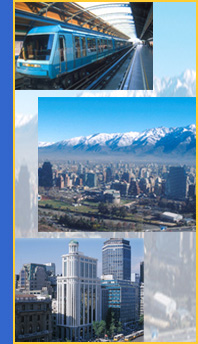
Central
Chile
Santiago, the capital, is a focal point of Latin American commerce and
the point of entry for nearly all international arrivals. Clean and modern,
Santiago sits in a basin between the Coast Range to the west and the Andes
to the east. World-class ski areas in the central Andes lie only forty-five
minutes away, up steep switchbacks which climb over 7500 feet in twenty-six
miles. Numerous vineyards surround the capital; hotsprings, seventeenth-century
colonial haciendas, and national parks in both the Andes and the Coast
Range, all make easy day trips. At night, visitors may choose from a variety
of restaurants serving all types of regional and Ethinc cuisines, and
excellent hotels assure a good night's sleep for business or pleasure.
To the west, modern highways connect with the coastal cities of Viña del
Mar, Valparaiso, and San Antonio. Like Santiago, the central coast enjoys
a Mediterranean climate, with short, mild winters and a sunny summer season
lasting over eight months. Here a chain of white-sand beaches and coastal
resorts offers something for every taste, from luxury hotels to secluded
cabañas, picnics on the beach to fresh seafood in an open-air restaurant.
To the north, the climate grows gradually hotter and drier. The chain
of beaches and resorts continues north to La Serena, Chile's second-oldest
city now known for its production of pisco, a grape brandy which follows
close behind wine on the list of Chile's preferred drinks.
To the south, the central valley comes into its own. These were the fertile
lands first claimed by the Spanish conquistadores; here the Chilean huaso
(cowboy) still spends his day astride his horse in the traditional manta
(poncho) and sombrero, honing his skills for annual rodeo competitions.
To the east, the Andes are an unforgettable presence, cloaked in white
in winter and spring, storing melt water for the rivers which irrigate
Chile's heartland. Beyond that first line of peaks, visible from anywhere
in the Central Valley and from many places along the coast, lies a wilderness
of glacially sculpted canyons, glaciers and microclimate forests, alpine
lakes and thundering rivers. Lateral roads lead into the cordillera, providing
access to numerous national parks and truly endless opportunities for
skiing, hiking and mountaineering, mountain biking, horseback riding and
rafting.
Information provides by http://www.visitchile.org